
Postzmaker guide
How to Write Original Greeting Messages That Sound Like You
The best greeting is rarely the cleverest one. It is the one that could only have been written to that person. Here is a simple structure, a tone for each recipient and what to leave out.
How to do it with Postzmaker
- Open the occasion page and read the suggested messages to get a sense of the length.
- Press ‘Another message’ a few times and keep one as raw material.
- Replace one general word with a detail only the recipient would recognize.
- Cut it to one or two short sentences.
- Type your version in the Message field and put the name in the ‘Name or dedication (optional)’ field.
- Read it aloud, check the preview, then send or download.
What makes a message feel original
Originality does not mean a rare word or a clever rhyme. A message feels original when it contains something that is true about this person on this day. ‘Happy birthday, Anna’ could go to any Anna. ‘Happy birthday, Anna, and thanks for the soup last winter’ could only go to one.
That is the whole trick, and it is easier than it sounds. Before you write, ask yourself one question: what do I actually remember or appreciate about this person? A trip, a habit, a joke, a favor, the way they laugh at their own stories. One of those, in a few words, does more than a page of general wishes.
Originality also means avoiding the phrases everyone has seen a thousand times. They are not wrong, but they carry no information. A reader’s eye slides over them. If you catch yourself writing ‘wishing you all the best’, stop and replace it with a specific hope: a quiet weekend, a good exam, a garden full of tomatoes.
A three-beat structure that always works
When you are stuck, use three beats. Beat one is the wish itself, in a handful of words: ‘Happy anniversary.’ Beat two is the true detail: ‘Twenty years and you still save me the last dumpling.’ Beat three looks ahead: ‘Here is to the next twenty.’ It takes about fifteen seconds to write and fits an image comfortably.
You do not always need all three. On a picture, two beats are often enough, because space is short: wish and detail, or detail and hope. The detail is the one you should never skip.
The order can change. Starting with the detail, as in ‘Nobody burns toast with as much confidence as you. Happy birthday!’, can be funnier. Starting with the wish is warmer and simpler. Choose according to the person.
Tone for each recipient
Tone is about the relationship, not the occasion. Grandparents and older relatives usually appreciate warmth and gentle respect: full sentences, no slang, one affectionate line. Parents like to hear specific gratitude. Close friends can handle teasing, inside jokes and a bit of drama.
Partners are the delicate case. Romance does not need big words; it needs one precise one. ‘I still like how you hum when you cook’ is more romantic than ‘you are my everything’. Children enjoy short, silly and rhythmic lines and the sound of their own name. Colleagues call for friendly but neutral: warm, light, nothing too personal.
Clients and managers are the most formal. A short, well-spelled line with a clear wish and your name is plenty. Skip jokes unless you know the person well, and skip anything that could be read two ways.
When you are unsure, go one notch warmer than formal and one notch calmer than funny.
Use humor without hurting
A funny line is a gift when it makes the person feel seen, and a risk when it makes them feel mocked. The safe kind of humor teases something the person is proud of or laughs about themselves: their terrible puns, their love of spreadsheets, their devotion to a sports team.
The unsafe kind targets age, weight, appearance, money or a sensitive situation. A birthday joke about getting old can fall flat for someone who is anxious about it. When in doubt, tease the habit, not the person.
Public images need more care than private chats. A joke that works in a two-person thread can be embarrassing in a family group of thirty. If the image will be seen by more people than the recipient, keep the humor gentle and the name kind.
A good test: would the person laugh if their best friend read it aloud at the party? If yes, send it.
One more distinction: you can tease an action, but be careful about teasing a feeling. ‘You burned the toast again’ is playful, while ‘you always overreact’ is a complaint in disguise.
Short enough for an image
Images need shorter words than messages. The text sits on a picture and has to be read in about two seconds, often on a small screen. A message of eight to twelve words is a comfortable target, with a title of two to four words above it.
How to cut: drop the greeting that the title already provides, remove stacked adjectives, replace ‘I hope that you will have’ with ‘Have’. Use concrete nouns instead of abstract ones: ‘a slow Sunday’ beats ‘relaxation and serenity’.
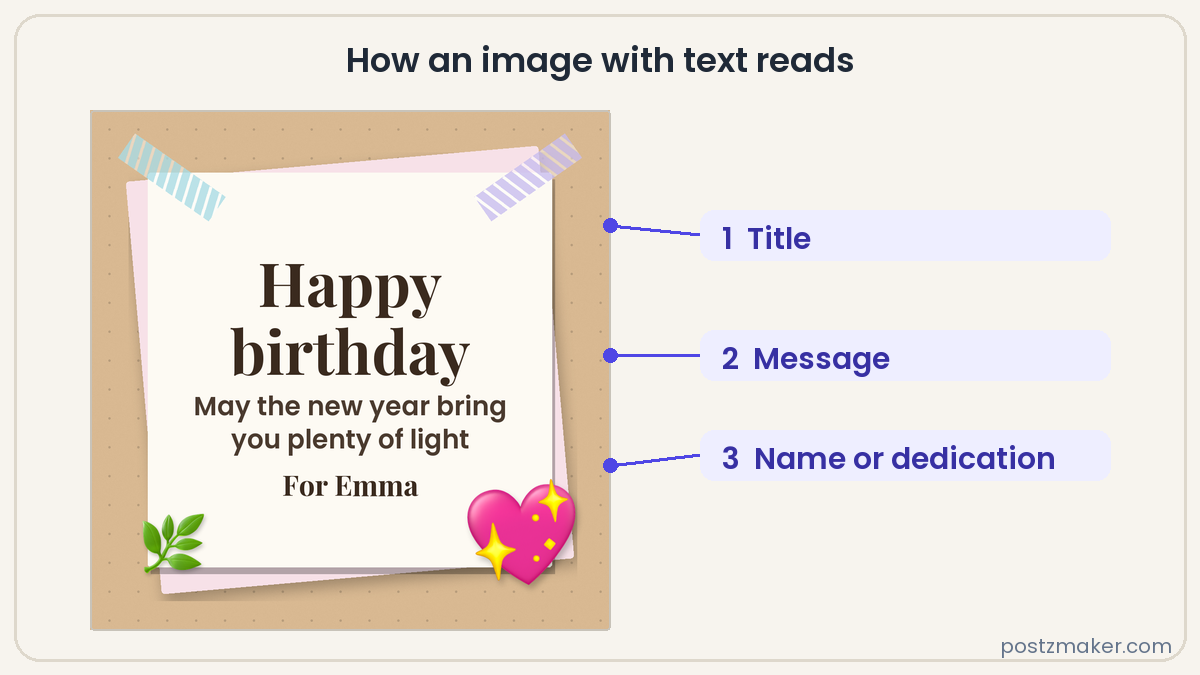
In the quick editor the fields are separate: Title, Message and Name or dedication (optional). Put the wish in the title, the detail in the message and the signature in the name field. If the message still looks long in the preview, it is long.
Keep the longer version for the message you type next to the image. The picture is the headline; the chat is where the full thought goes.
A tip: once you have the short version, read it once more and ask whether any word is doing no work. ‘Really’, ‘very’ and ‘just’ usually are.
Phrases to avoid
Some phrases are so worn that they sound automatic: ‘wishing you all the best’, ‘may all your dreams come true’, ‘sending you love and light’, ‘on this special day’. They are not offensive, but they could be sent by a bank. Replace them with a detail and the same warmth lands twice as well.
Avoid advice and verdicts. ‘You should relax more’ turns a greeting into a lecture. Avoid comparisons with other people. Avoid anything that sounds like a sales slogan.
Also be careful with sensitive topics. Do not mention age pointedly, health, money, weight or family tensions in a public greeting. For sad or delicate moments, such as an illness, a short, sincere line is best. Skip the phrases that attempt to explain or fix.
Finally, never copy a famous quotation as if it were yours. A short, honest sentence of your own is better than a borrowed line you do not quite mean.
How to find ideas when your mind is blank
Start with a list of five facts about the person: something they love, something they do every day, something they said recently, something you did together, something they are looking forward to. Pick the most vivid and build the message around it. An old photo or your chat history with them usually turns one up within a minute.
Another approach is to use a suggestion and change it. In the quick editor, ‘Another message’ cycles through ideas for the occasion. Treat them as scaffolding: keep the rhythm, swap the words, add your detail. A suggestion with one real word replaced already reads like your own.
You can also borrow structure rather than words. Take the sentence ‘May your coffee be strong and your Monday gentle’ and apply it to the person: ‘May your boat be steady and your catch be large’ for a fisherman, ‘May your code compile and your tea stay hot’ for a developer.
Last, read your message after a short break. What looked clever five minutes ago may look forced; what looked plain may look just right.
Check and send
Before you send, run a four-point check. Is the name spelled correctly? Is the message short enough to read on a phone? Does it sound like something you would say to that person? Does it avoid anything they might find awkward?
Then look at the whole image. The words should sit in the calm part of the picture, with strong contrast and generous margins. The title should be bigger than the message, and the message bigger than the name. If any of that is off, adjust before you send; a minute here saves an awkward reply later.
If you want to change the typeface or move the text, use ‘Open in the full editor’. And if you wrote a line you like, keep it: a note on your phone with your best lines makes the next card faster.
Examples: original lines for different people
- For a grandmother: Your kitchen is still the warmest room I know.
- For a best friend: Thirty years of bad jokes, and I would not trade one.
- For a partner: I still like how you hum when you cook.
- For a child: Seven candles, one wish, and a very big slice for you.
- For a colleague: Thanks for answering my ten silly questions with a straight face.
- For a teacher: You made fractions feel like a game. Thank you.
- For a new parent: Sleep is overrated. Cuddles are not.
- For a friend with an exam: You have done the work. Now go be brilliant.
- For a neighbor: Thanks for watering the plants and never mentioning the dead one.
Try it now
 🎂 Happy birthday images to personalize and send60 images
 🤗 Friendship quotes images for the people who stay48 images
 ❤️ Love quotes images to send to the one you love48 images
 🙏 Thank You Images to Personalize and Send42 images
 🍀 Good Luck Images and Messages48 images
 🌻 Get Well Soon Images with Warm Wishes42 images
Frequently asked questions
How do I write a greeting that is not generic?
Include one true detail about the person: a shared memory, a habit, a small favor or a joke you both know. Keep the wish itself short and let the detail do the work. ‘Happy birthday, Anna, and thanks for the soup last winter’ feels personal, while ‘wishing you all the best’ could be sent to anyone.
Should a greeting rhyme?
Rhymes are fun for children and for light, joking lines. For a partner, a parent or a colleague they can sound like the verse inside a store-bought card. If you do rhyme, keep it to two short lines and let the detail, not the rhyme, carry the message.
Can I copy the suggested messages?
Yes. The messages on Postzmaker are original, and you can use them in your own messages. They work best as a starting point: change one or two words to add a detail only the recipient would recognize, and the line will sound like it came from you.
Is it okay to use humor in a greeting?
Yes, if the joke teases something the person is proud of or laughs about themselves. Avoid jokes about age, weight, money or appearance, especially if the image will be seen by a group. A good test is whether the person would laugh if a friend read it aloud.
What tone should I use with a boss or a client?
Short, warm and correctly spelled. State the wish clearly, sign your name and skip jokes unless you know the person well. Choose a calm style such as Minimal and avoid anything that could be read two ways. Formality is a form of respect, not coldness.
What if I really cannot think of anything to write?
Write down five facts about the person, such as something they love or something you did together, and build one sentence from the most vivid. You can also press ‘Another message’ in the quick editor and change a word or two. A short sincere line beats a long polished one.
More guides
- How to Make Good Morning Images for WhatsApp
- How to Make a Greeting Card Online for Free
- How to Make a WhatsApp Status with Text and a Background
- How to Choose the Right Background, Colors and Font
- How to Prepare a Different Image for Each Day of the Week
- Birthday messages for every person on your list
- Christmas and New Year wishes: what to write, to whom and when
- Valentine’s Day messages that are not clichés
- Mother’s Day and Father’s Day: dates, messages and ideas
- Why WhatsApp images look blurry, and how to send them sharper
- Workplace greetings: coworkers, clients and your boss
- How to Make Images Everyone Can Read
- Plan Your Year of Greeting Posts, Month by Month
- What to Write for Weddings, New Babies and Graduations
- Writing to Someone Who Is Unwell or Going Through a Hard Time
- How Holidays Differ Between Italy, Spain and English-Speaking Countries
- The Full Editor, Step by Step